
What if the kind of books you read slowly changed how your mind works, not just what you remember for exams, but how you think every day?
Most students divide reading into two clear categories. Nonfiction is for studying, exams, and serious learning. Fiction is seen as something optional, meant for free time, maybe after the syllabus is done, if there is any energy left. Because of this, many students feel fiction is less important or even a waste of time during preparation.
But students who read regularly often notice something interesting. Those who read both fiction and nonfiction do not just perform better academically. They feel calmer while studying. Their thinking feels clearer. They do not get overwhelmed as easily. This difference is not accidental.
Fiction may not look productive on the surface. There are no formulas to memorise, no direct exam questions, and no obvious outcomes. That is why many students feel guilty spending time on it. But fiction works quietly in the background. When you read a story or a novel, you naturally slow down. You stay with one idea for longer. You imagine situations instead of being shown everything. You follow thoughts, emotions, and decisions over time.
This slowly trains patience and attention. For students, this shows up during long study hours, especially when sitting still feels harder than understanding the topic itself. Students who read fiction regularly are often more comfortable being alone with their thoughts. They feel less restless. They do not feel the urge to constantly check their phone. Their mind does not panic the moment something feels difficult. Fiction does not rush the brain. It teaches the brain how to stay.
Nonfiction, on the other hand, feels more directly useful, and it is. It provides structure, clarity, and direction. It helps students understand concepts, systems, arguments, and logic. For exam preparation, this matters a lot. Nonfiction reduces confusion and builds confidence because you can clearly see what you are learning and why.
But many students face the same problem. They read a lot of nonfiction, highlight pages, and feel familiar with the content. Then, during revision or exams, they realise they cannot explain it properly. This does not mean nonfiction does not work. It usually means reading alone is not enough.
The real issue is balance. Fiction prepares the mind, while nonfiction fills it. Fiction builds attention and patience, while nonfiction provides knowledge and structure. When students read only nonfiction, mental fatigue builds quickly and studying starts to feel heavy. When students read only fiction, thinking may feel rich, but academic depth remains weak. Students who read both usually feel more balanced. Studying feels less stressful. Thinking feels smoother. They do not just recognise answers. They understand them.
One more thing matters more than students realise, and that is the space in which they read. Even the best books struggle in distracting environments. In noisy or chaotic spaces, fiction turns into casual entertainment and nonfiction starts to feel like a burden. Focus breaks easily, and reading becomes shallow.
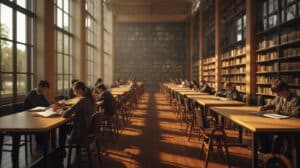
This is why libraries have always helped students. Not because anyone is watching, but because the atmosphere itself feels calm and serious. The mind settles faster in the right environment. The same idea can work online too.
That understanding is why The Reading Room was created. It is a quiet online space where students and readers sit together with cameras on, simply reading or studying in silence. In a space like this, fiction naturally feels deeper and nonfiction feels easier to handle, not because you are forcing discipline, but because you are no longer fighting distractions alone.
That’s where our initiative, The CA in Me (Virtual Library), also known as The Reading Room, comes into play.
Reading stops feeling like something you should do and starts feeling like something you can do every day.
So instead of asking whether fiction or nonfiction is better, a more useful question might be this:
what kind of space would help you read more, whether it is fiction or nonfiction?